Achieving and sustaining accreditation from the National Accreditation Board for Hospitals & Healthcare Providers (NABH) is the ultimate benchmark of healthcare quality and patient safety in India. However, for hospital owners, clinical directors, and administrators, the journey to compliance is notoriously demanding. It requires navigating hundreds of stringent objective elements, restructuring operational workflows, managing massive documentation overhauls, and shifting an institutional culture toward continuous quality improvement.
At Meddicine, we step in as your strategic compliance partners, taking the entire weight of the accreditation process off your shoulders so your clinical teams can remain focused on their core mission: delivering exceptional patient care.
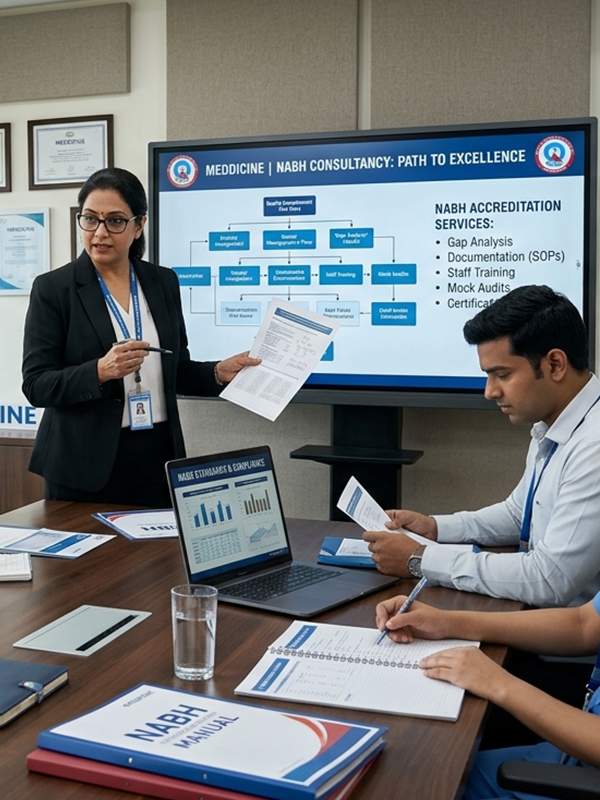
We simplify the accreditation journey with a structured roadmap from baseline assessment to final on-site assessment.
Conducting a multi-departmental audit evaluating existing clinical workflows, infrastructure, biomedical engineering, and records against latest NABH standards.
Drafting tailored hospital standard operating procedures (SOPs), manuals, infection control policies, forms, and clinical registers without generic copy-paste templates.
Interactive quality sessions for doctors, nursing in-charges, pharmacists, paramedics, and support staff to ensure genuine daily implementation of safety standards.
Establishing robust bio-medical waste segregation, sterilization practices, hazard identification, and clinical governance protocols meeting strict national norms.
Simulating real NABH on-site inspections through rigorous mock assessments, closing non-conformances (NCs), and verifying clinical audit trail readiness.
End-to-end guidance during Desktop Assessment, Pre-Assessment, Final Assessment, and continual post-accreditation quality assurance maintenance.
Achieving accreditation delivers immense measurable benefits to healthcare organizations, doctors, and patients alike:
Standardized clinical protocols drastically reduce medical errors, hospital-acquired infections, and adverse incidents.
NABH-accredited hospitals receive preferential empanelment with government health schemes (such as Ayushman Bharat, CGHS, ECHS) and higher insurance reimbursement rates.
Clear role definitions, standardized documentation, and regular internal audits streamline daily hospital operations and staff accountability.

Clear answers regarding NABH timelines, requirements, documentation, and consultancy assistance.
The National Accreditation Board for Hospitals & Healthcare Providers (NABH) is a constituent board of the Quality Council of India (QCI) established to establish and operate accreditation programmes for healthcare organizations in India based on international standards.
NABH accreditation validates a hospital's commitment to patient safety and quality care. It enhances institutional credibility, improves clinical outcomes, qualifies facilities for top insurance empanelments, and fosters continuous medical improvement.
Hospitals (all bed capacities), nursing homes, day-care centers, clinics, dental facilities, diagnostic and imaging centers, blood banks, eye centers, and AYUSH hospitals are all eligible to apply.
The timeline typically ranges between 3 to 9 months depending on the hospital's size, current documentation maturity, infrastructure readiness, and whether you are targeting Entry-Level NABH or Full Accreditation.
Gap analysis is the initial diagnostic review comparing your facility's current policies, infrastructure, infection control, and clinical records against NABH objective elements to pinpoint exactly what needs to be upgraded.
Yes. Meddicine authors and customizes all required quality manuals, clinical SOPs, departmental policies, disaster management plans, credentialing files, and audit registers compliant with NABH standards.
Yes. Staff awareness is heavily assessed by NABH assessors. Every team member—from consultants and nurses to housekeeping—must understand their specific role in emergency codes, fire safety, infection control, and patient rights.
Yes, both long-established hospitals and newly built healthcare centers can apply for NABH accreditation to formalize and elevate their clinical workflows.
Significantly. Patients today actively seek out accredited hospitals knowing that clinical care, surgical sterility, emergency preparedness, and billing transparency are rigorously monitored by an independent national authority.
An expert consultant prevents costly trial-and-error, reduces preparation time by over 50%, spares doctors and nurses from administrative burnout, ensures non-conformances are averted, and guarantees a seamless accreditation inspection.